Want to source goods from China but overwhelmed by a multitude of research tasks? Should you personally select factories or delegate the process to a purchasing agent? Today, we'll explain the ins and outs of both methods in the most practical terms, applicable to both beginners and experienced sellers!
If You're Looking for Actual Factories: Every Step Below Is Crucial, Or You'll Suffer Significant Losses!
Directly connecting with Chinese factories may seem to save on intermediary fees, but every step involves subtle details. A slight oversight can easily lead to problems. These key points must be closely monitored!
Check if they're a real factory—not just a trading company.
Don’t be fooled by a glossy website or smooth sales talk. Some trading companies dress themselves up as manufacturers. They quote high prices but have zero control over production. A real factory has its own production facility. They manage every step of manufacturing. That’s the foundation you should build on.
Factory size, employee count, production line photos or videos.
Anyone can claim they have capacity. But factory size and employee numbers are hard facts. Real photos and videos of production lines are even better—they show you exactly what you’re getting. They also help you spot the difference between a serious factory and a small workshop pretending to be one.
Check for IP violations, counterfeit production, or blacklist history.
Intellectual property enforcement is strict in EU/US markets. Work with a factory that has a record of infringement or counterfeiting, and your shipment could be held at customs—or worse, you could face heavy fines. If a factory is on an industry blacklist, just walk away.
Look for OEM/private label experience.
Factories with solid OEM or private label experience already understand overseas product standards and packaging requirements. You won’t waste time going back and forth on basics. It’s a smoother process—especially if you’re new to sourcing.
Check if they support customization, mold modification, or OEM/ODM services.
Most overseas buyers need some level of customization. A factory that supports design changes, mold adjustments, and full OEM/ODM services is far more flexible. They can handle different product types and specifications without missing a beat.
Ask about their QC process, inspection sampling rate, and defect rate.
Quality is everything in cross-border business. A clear quality control process, a defined sampling rate, and transparent defect rate data tell you exactly how seriously a factory takes quality. Without them, you’re risking a batch of defective products you’ll be stuck with.
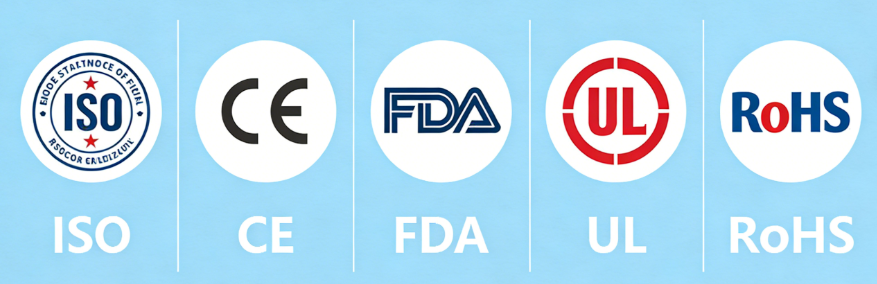
Check certifications: ISO, CE, FDA, UL, RoHS, etc.
Why are these certifications essential?
These are your entry tickets to Western markets.
Without CE or RoHS, your goods often cannot clear EU customs.
FDA is required for food, medical, and related products.
UL is critical for safety compliance in North America.
ISO proves a reliable quality management system.
Missing any can lead to delays, fines, or rejected shipments.
Confirm whether products are originally designed and patented
What are the benefits of having patents?
Patented products protect you from IP disputes and copycats. They also give you a unique advantage in overseas markets, helping you avoid price wars and build sustainable sales.
Clarify after-sales and return costs
Never wait until problems happen to discuss responsibility. Clear after-sales terms and return policies prevent unexpected costs and disputes.
Understand how shipping damage and customs risks are handled
Damage during transit and customs hold-ups are common. Always confirm compensation rules and who handles customs issues in advance.
Strictly avoid vague quotes and hidden price increases
Vague pricing is a red flag. Factories that later raise prices due to “material cost increases” or “packaging upgrades” should be avoided. Transparent pricing is a must.
Check on-time delivery reliability
Western buyers rely heavily on stable lead times. Frequent delays can ruin your sales schedule and even lead to contract penalties.
Ask about their freight forwarders and shipping partners
Reliable forwarders and carriers ensure better timing, lower risks, and more stable shipping costs.
Confirm whether small trial orders are accepted
For new partners, always start small. Factories that accept trial orders let you test quality with minimal risk.
If You Work Directly with a China Sourcing Agent
What are the benefits of using a China sourcing agent?
For foreign buyers: what takes weeks or months alone can take days with an agent.
Researching the Chinese supply chain, vetting factories, and verifying qualifications can take months for newcomers. Sourcing agents already have trusted factory databases and can shortlist reliable options in days.
The biggest value: agents spot unreliable factories instantly because they’re on the ground every day.
Examples:
Source agent in China can immediately spot“shell factories” by checking actual workshops, equipment, and production flow.
They recognize inflated pricing and corner-cutting tactics that most foreign buyers would miss.
They know industry reputations and can easily avoid factories with a history of delays, poor quality, or IP issues.
Why do 90% of small to mid-sized buyers, traders, and e-commerce sellers use sourcing agents?
Most smaller buyers and online sellers don't have the time or experience to deep-dive into China’s supply chain. A good agent handles factory selection, factory audits, quality control, logistics, and customs. They can provide excellent quality control in supply chain.
You pay for expertise, save massive time, and greatly reduce risk — making it the most practical choice.
What to avoid when choosing a sourcing agent
Avoid agents who can't inspect factories, judge quality, or control risks.
Some agents only act as translators or messengers. They provide no real inspection or risk control — a complete waste of money.
Make sure the agent offers deep, full-process service.
Don't settle for agents who only "find factories."
A professional agent should cover the entire chain:
factory sourcing → sampling → production follow-up → inspection → customs → shipping.
Only then can you truly relax and focus on your business.




 English
 日本語
日本語 한국어
한국어 русский
 tiếng việt
 ไทย
ไทย